
|
|
|
|
2005 Seated Dime Variety Discoveries
1868 Business Strike Blundered Obverse Confirmed By PCGS
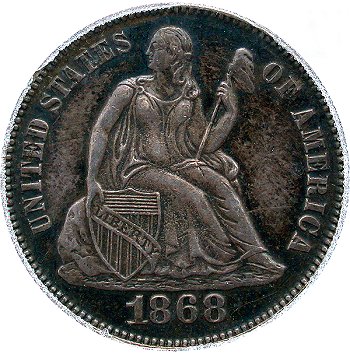
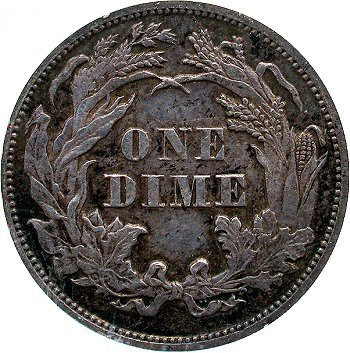
What I believed to be a business strike example of the difficult 1868 Proof Blundered Obverse Die has been located and graded AU55 by PCGS. This variety has been added to the web-book as 1868 F105a. The recently acquired 1868 dime does not have the sharp strike and proof fields typically found on Seated Dime proof dimes. Thanks to PCGS for confirming the existence of a rare 1868 business strike Blundered Obverse die example.
1875-S Below Wreath Small Filled S (Breen's Tall Narrow S) Identified
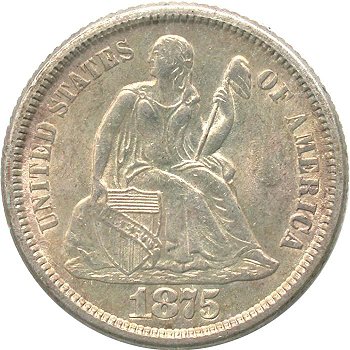
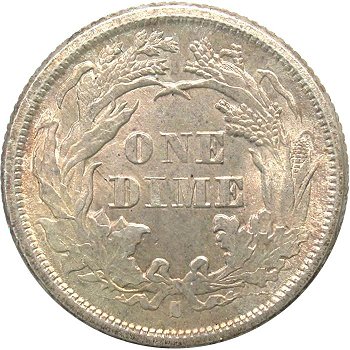
During March, an 1875-S Below Wreath dime was purchased with a Small Filled S mintmark. Up to this point, I had not seen an example of the Small Filled S mintmark on 1875 dimes, but only on 1876-S and 1877-S dimes. I consider this Small Filled S to be the Tall Narrow S mintmark referred to by Breen and Greer. After measuring the height and width of both the Small Filled S and Small Block S mintmarks, I must agree with Greer that both mintmarks originated from the same mintmark punch, though the Small Filled S appears to be taller and bolder than the Small Block S mintmark.
Breen lists a below wreath Tall Narrow S mintmark as B-3381 and considered the variety to be rare. He continues to list a Tall Narrow S mintmark for the 1876-S Type I reverse (B-3393) and the Type II reverse (B-3394). Also for 1877-S, Breen lists B-3404 as a Type II reverse with a Tall Narrow S mintmark. In subsequent listings of San Francisco 1876 and 1877 reverse dies, Breen's Tall Narrow S mintmark will always be listed and described as a Small Filled S mintmark.
Early Die State of 1839 Pie Shaped Shattered Obverse is Located by Gerry Fortin
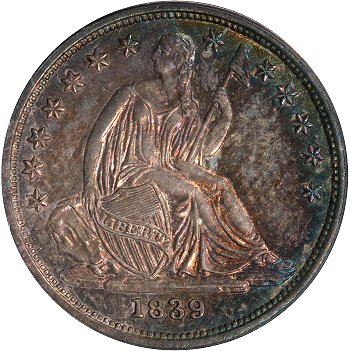
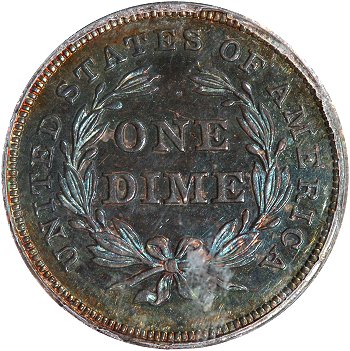
After countless years of searching for an example of the 1839 Pie Shaped Shattered Obverse without any die cracks, an original high grade specimen was located and cherrypicked on eBay during March. This is the first known example of this die state. Now that I have confirmed its existence, it will be listed at an initial rarity of R8. The plate coin grades an original AU55, being well struck on both the obverse and reverse. The discovery of this early die state specimen confirmed that the mint did employed the Obverse 2 die for a limited amount of coinage with the obverse die probably shattering early in its production life. Few examples are extant of any of the die states for Obverse 2 with the terminal die state (Variety 105b) being a cherished prize for Seated Dime variety specialists.
December 2005 Update: I have lowered the rarity rating for 1839 F-105 from R8 to R6 after locating or knowning of several examples in the past year. Caution is advised for paying a premium for the F-105 variety at this time.
Fifth 1879 Obverse Die Identified By Jim Smith
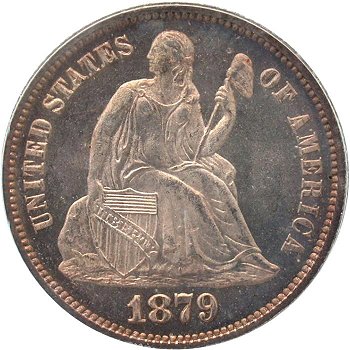
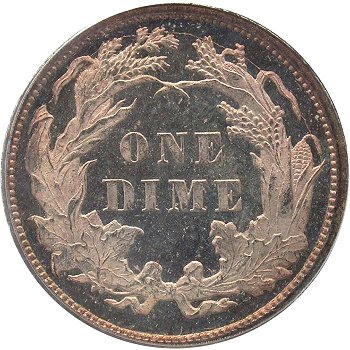
Jim Smith has identified a new 1879 die pair. His coin featured a new obverse die with a date punch position of DR 1L. The reverse die is in a later die state with a radial crack from the right ribbon, up through the right wreath and across into the top of the left wreath. I believe the reverse die is a new discovery since there are a series of parallel die scratches in the left wreath at 9:00. With a low mintage of 15,100 pieces, it is surprising to see five obverse dies being employed for the combination of proof and business strikes. I've initially listed the rarity of the F105 variety at R5 in VF or better.
December 2005 Update: I have lowered the rarity rating for 1879 F-105 from R5 to R4 after knowning of three mint state examples in the past year including the Lemus specimen which is illustrated here as the plate coin.
Second Proof 1883 Obverse Die Identified By Paul Bradley
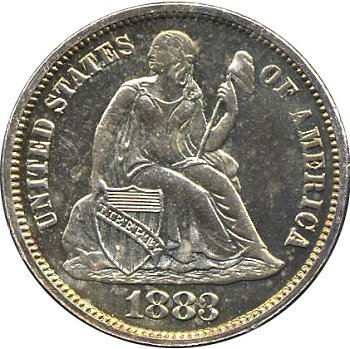
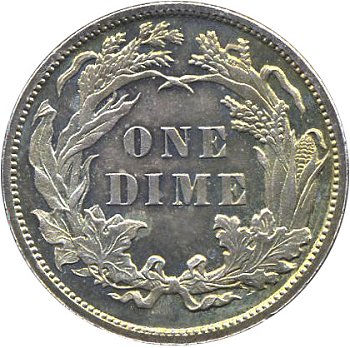
During June 2005, Paul Bradley identified a second 1883 proof obverse die. The second proof die features a date punch position of DR -1B0. This date position is significantly more left than the date position of the more common 1883 proof obverse. To determine availability, I performed a review of the Heritage Auction Archives. About three in ten proofs were from the second obverse die discovered by Paul.
1877-CC Obverse Die With Misplaced 7 Digit In Denticles Discovered By Dick Osburn
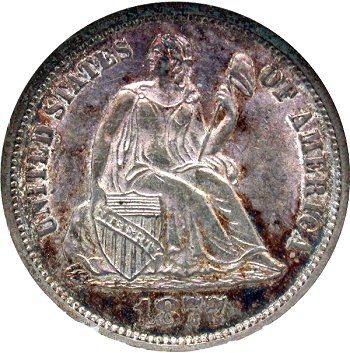
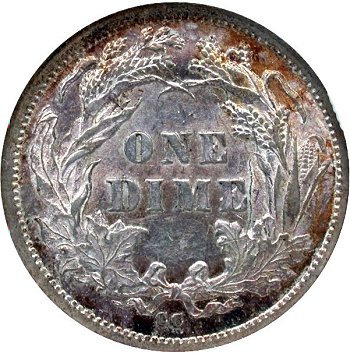
Dick Osburn has recently located an 1877-CC Type II reverse seated dime with what appeared to be an extra 7 digit protruding out of the denticles under the date punch. I bought the dime from Dick and immediately confirmed, through overlays of two digital images that the shapes appearing out of the denticles are indeed the left and right tops of a 7 digit.
1850-O Large O Rotated Reverse Identified By Dick Osburn
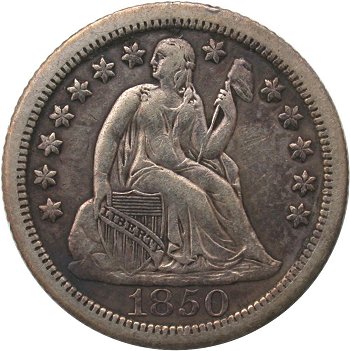
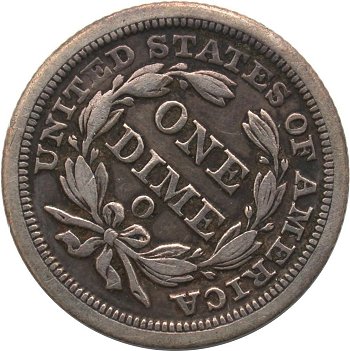
Dick Osburn emailed me with yet another new Seated Dime variety for the web-book. Dick identified a rotated reverse on a low grade 1850 New Orleans dime that he recently purchased during November 2005. Reverse B (Variety F-105 die pairing) is rotated left by approximately 45 degrees on the above specimen. This is the first discovery of a rotated reverse for 1850 New Orleans coinage.
We should not be surprised to find an 1850 New Orleans dime
with a rotated reverse considering that three of the four 1849-O die pairings
produced a rotated reverse situation. From this new evidence, we know that the
systematic die alignment problem that plagued the New Orleans mint in 1849 extended
into 1850.