
|
|
|
|
1873
No Arrows - Closed 3
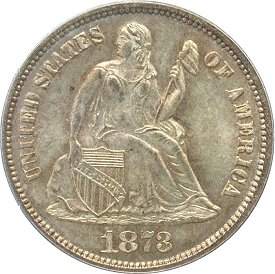
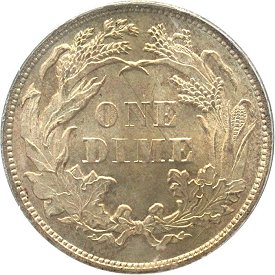
Mintage: 1,508,000 Proofs: 600
|
Var# |
Obv |
Rev |
DR |
|
Obverse / Reverse Quick Diagnostics |
Ahwash |
Greer |
|
|
|
1 |
A |
1L |
|
Proof Die, Medium Date, Downward Slope, Broken S / Proof Die |
A-1 |
|
|
|
|
1.2 |
A.2 |
1L |
|
Medium Date, Downward Slope, Broken S / Perfect Die |
A-1 |
|
|
|
|
2 |
B |
0C |
|
Medium Level Date, Partial S, Die Lines In Shield / Perfect Die |
A-2 |
|
|
|
* |
3 |
C |
1C |
|
Repunched Date, Medium Level Date, Broken S / Perfect Die |
|
G101 |
|
|
* |
3.2 |
C.2 |
1C |
|
Repunched Date, Cracked Die, Med Level Date / Cracked Die |
|
G101 |
|
|
|
4 |
D |
0L |
|
Repunched 73, Medium Date, Slight Downward Slope / Perfect Die |
|
G102 |
|
|
|
5 |
E |
0B1 |
|
Repunched 1, Medium Level Date / Circular Die Crack In Wreath |
|
G103 |
|
|
|
6 |
F |
0B1 |
|
Med Date, Slight Down Slope, Broken S / Perfect Die |
|
|
|
|
6 |
F.2 |
0B1 |
|
Med Date, Slight Down Slope, Broken S / Circular Die Crack In Wreath |
||||
|
|
7 |
F.2 |
0R |
|
Chin Whisker, Medium Level Date / Circular Die Crack In Wreath |
|
|
|
|
8 |
G |
0R |
|
Medium Level Date / Circular Die Crack In Wreath, Open 3 Reverse B |
Variety Vs. Denticle Ruler Cross Reference Table

Scarcity: A marginally common date that becomes scarce in EF or better.  Finding well struck Mint State examples can
be very difficult.  Mint State 1873 Closed 3 dimes with fully struck heads are currently underrated.

Updated Greer Rarity Ratings
Overall Rarity: G-VG R2, F-VF R2+, EF-AU R4-, MS R5-

                                Fortin Variety Rarity Estimates In VF - Mint State
| Variety |
Rarity |
Variety |
Rarity |
||
|
R3 |
- |
R3 |
- |
||
|
R3 |
- |
R4 |
- |
||
|
R2 |
- |
R3 |
- |
||
|
R3 |
30-50% |
R4 |
- |
||
|
R3 |
30-50% |
R4 |
- |
||
|
R4 |
50-100% |
Comments: 1873 Closed 3 dimes have a reputation for having weakly struck heads. This observation may be tied to the high availability of Obverse 2 which is almost always flatly struck. Obverse 5, with the repunched 1, comes with a well struck head. Obverse dies in later die states with die cracks are most difficult to locate. However the reverse dies often show circular die cracks in the wreath as is the case for Varieties 105 through 108. All 1873 No Arrow proof dimes come with a Closed 3 date. Ahwash states that two Closed 3 obverse dies were employed for proof coinage. I have only seen proof examples from Obverse 1 and have decided to removethe Variety 102 proof listing after careful research of 1873 No Arrows Closed 3 proof dimes offered at auction over a long period of time. 1873 No Arrow dimes are found with Open and Closed 3 digits. This difference came about in early in 1873, before and after the omnibus Mintage Act of February 12, 1873 which attempted to introduce metric weights for United States coinage. An article in the October 10, 2005 issue of Coin World provides ample insight into the historical background for Open and Closed 3 date seated dimes. Within the Coin World article, Eric von Klinger presents an excerpt from a series on 1873 coins in the Numismatic Scrapbook Magazine dating from March 1957 to December 1958. A. Louden Snowden, chief coiner of the Philadelphia Mint, wrote to Mint Director James Pollack on Jan 18, 1873: "I desire in a formal manner to direct your attention to the 'figures' used in dating the dies for the present year. They are so heavy, and the space brtween each so small that upon the smallest gold and silver, and upon the base coins it is almost impossible to distinguish with the naked eye, whether the last figure is an eight or a three. I do not think it creditable to the institution that the coinage of the year should be issued bearing this defect in the date." Incremental research of Closed 3 and Open 3 reverse die pairings suggests that reverse dies were shared between the dies with Closed and Open 3 date punches. One would assume that Open 3 dimes were struck after Closed 3 dimes due to the leadtime necessary to prepare "improved" Open 3 obverse dies. This assumption may not be completely accurate as Closed 3 Variety 108 dimes were struck with a reverse die initially paired with an Open 3 obverse. More research is required in this area. Value As A Date (Coin World Trends/CoinValues
| Grade |
1963 |
1973 |
1983 |
1993 |
2003 |
2012 |
|
G |
1.25 |
2.5 |
12.5 |
9 |
20 |
18 |
|
F |
4 |
5 |
22.5 |
19 |
30 |
25 |
|
EF |
- |
17.5 |
45 |
40 |
40 |
40 |
|
MS60 |
17.5 |
90 |
285 |
170 |
200 |
200 |
|
MS63 |
- |
- |
- |
350 |
400 |
500 |
Back to Date and Mintmark Table